The two books, part by part, in plain words
You do not need a background in HR or finance. Each part says what the book argues, then what it means in plain words. At the end: how the two books became one system.
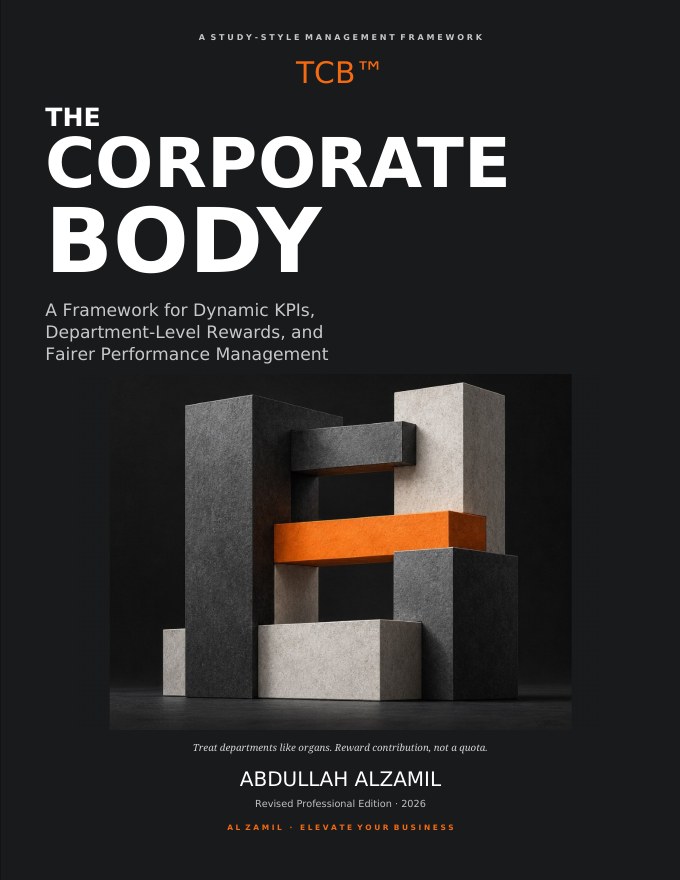
TCB: The Corporate Body
A new way to share variable reward. Before the period, the company fixes a pool and a weight for each department's expected contribution. After the period, real performance and health checks decide what each department earns.
The case for change
Many companies force staff ratings into a fixed shape, the bell curve. In a team of ten, only one may get the top rating and at least one must be placed at the bottom, even when nobody underperformed. The book names five hidden costs: talent flight, collaboration tax, manager disengagement, risk concealment and short-termism.
The biology of contribution
A company works like a living body. Departments are its organs: different roles, all depending on each other. In the body, size is not importance: the brain is about 2% of body weight yet uses about 20% of resting energy. In the same way, a small department can carry a large part of a product's success.
Building the model
Five working tools: a map of departments to organs, a comparison of each department's headcount share with its reward share, a map of each product's life stages, a matrix of who contributes what at each stage, and one reward formula. The formula takes the fixed pool, multiplies it by the department's agreed weight and its achieved performance, caps it at a ceiling, applies the Health Gate and rounds down. Money not earned stays unpaid; it does not move to another department.
Putting it to work
Templates and a full case study: credit cards in a bank, followed across its first years. When the product is new, the departments that win customers carry more weight. As it matures, weight moves to those who serve and keep customers. Further examples cover other industries.
Governing, implementing and proving it
The risks and safeguards, a phased roadmap and a way to test the model honestly. It starts with a 90-day simulation and a shadow pilot on one product, with no change to anyone's pay. The book calls itself a proposed experiment and invites organisations to test whether it improves fairness.
TCB: The Company Beyond Rewards
The sequel follows the same body beyond pay: to connected performance, development, succession, health and recovery. It is built on four pillars. Each answers one question, and none may quietly do another's job.
Also in Book Two
Development that prescribes the capability, not the course. Progression without waiting for a vacancy. Succession as a culture, not a secret list. Leadership accountability without automatic blame. AI as an assistant, never the decision-maker. And one complete worked example: the five-year journey of Namaa Horizon Bank, a fictional bank.
A method on paper needs spreadsheets. A method in a system just runs.
The four pillars need the same facts: who works where, who reports to whom, what was agreed, what was achieved, what customers said and what it cost. In most companies those facts sit in separate systems. So we built one. TCB Core puts the four pillars on the same platform as people, finance, customers and service, so every number comes from the work itself and can explain itself.