THE CORPORATE BODY
العربية Register interest
THE BOOKS

Read it. Then work it.

Two books set out the method in full. The first shows how to share rewards fairly between departments. The second widens the view to the health of the whole organisation.

Read both in ten minutes
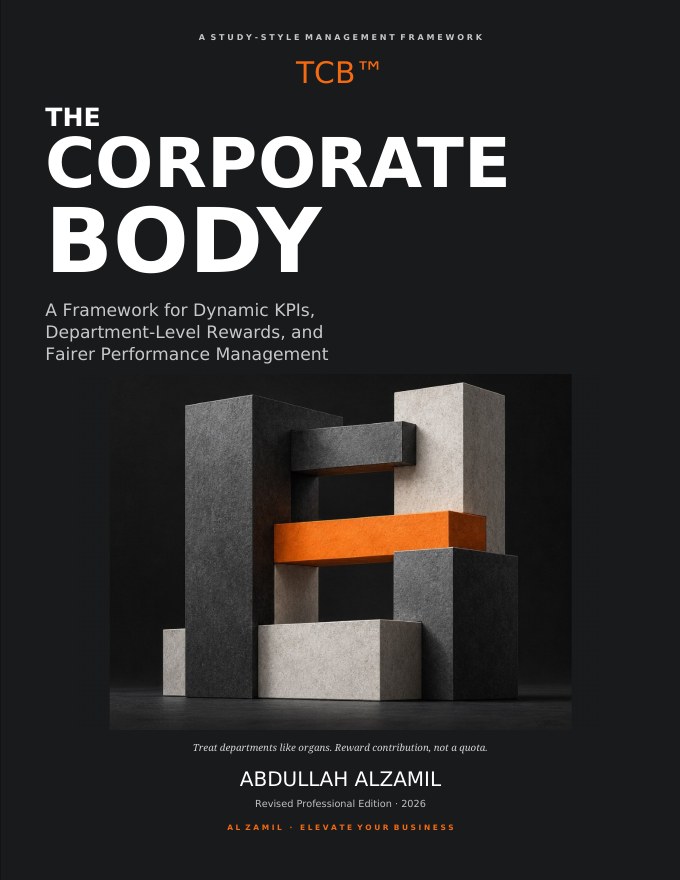
Cover of TCB: The Corporate Body
BOOK ONE · REVISED PROFESSIONAL EDITION 2026

TCB: The Corporate Body

A framework for dynamic KPIs, department-level rewards and fairer performance management.
THE ESSENCE OF THE BOOK

Most companies decide in advance how many people may be rated "excellent", then fit their people to that shape. Good work goes unrewarded and departments compete with each other. This book looks at a company as a human body: every organ matters, and none is ranked against another. It shows how to share rewards between departments by what each one contributed, using evidence that everyone can see.

Who it is for: chief executives, heads of human resources and anyone who decides bonuses.
14 chapters
and 13 appendices
A full case study
a credit-card product, worked through
Templates
and decision rules to reuse
Buy on Amazon Coming soonRead the executive summary
See the 14 chapters, and what each one covers
PART I · The case for change
  1. 1The Problem with Traditional KPIs and Bell Curves
    How forced distribution quietly replaces the truth of performance with the shape of a curve.
PART II · The biology of contribution
  1. 2Anatomy of the Human Body: Weight, Energy, and Purpose
    Why a small organ can demand enormous energy, and what that teaches us about rewarding departments.
  2. 3The Company as a Living Body
    Trading the language of machines for the language of living systems, and why it changes the reward conversation.
PART III · Building the model
  1. 4Mapping Departments to Organs
    A shared map of who does what, organised by function, not by job title.
  2. 5Weight Ratio vs. Calorie Ratio
    Three different questions: how large is the department, what share of final gross awards did it receive, and what value can credibly be attributed to its work?
  3. 6Products as Body Activities
    Each product is a different activity (running, resting, digesting) and each draws on a different mix of organs.
  4. 7The Dynamic Contribution Matrix
    The central instrument of the model, where analogy becomes a disciplined, evidence-based business tool.
  5. 8From Contribution to Reward Formula
    Turning the analogy into arithmetic: a single, explainable formula and the safeguards that keep it honest.
PART IV · Putting it to work
  1. 9Templates and Practical Tools
    Seven working templates that move the model from theory to a Monday-morning starting point.
  2. 10Case Study: Credit Cards in a Bank
    A detailed, three-year walk-through showing contribution shifting from sales to service, and why operations is the heart.
  3. 11Additional Industry Examples
    The same logic, re-weighted: software subscriptions, manufacturing, and healthcare each activate different organs.
PART V · Governing, implementing, and proving it
  1. 12Risks, Safeguards, and Governance
    Every incentive can be gamed. This chapter attacks the model on purpose, and arms it against its own failure modes.
  2. 13Implementation Roadmap
    Not a company-wide switch, but a staged experiment: one product, one cycle, measured and improved.
  3. 14Study Design and Validation Proposal
    A model presented as an experiment deserves to be tested like one, with hypotheses, measures, and honest limitations.
Plus 13 appendices: a formula summary, worked calculations, a 90-day pilot checklist, sample scorecards and decision rules.
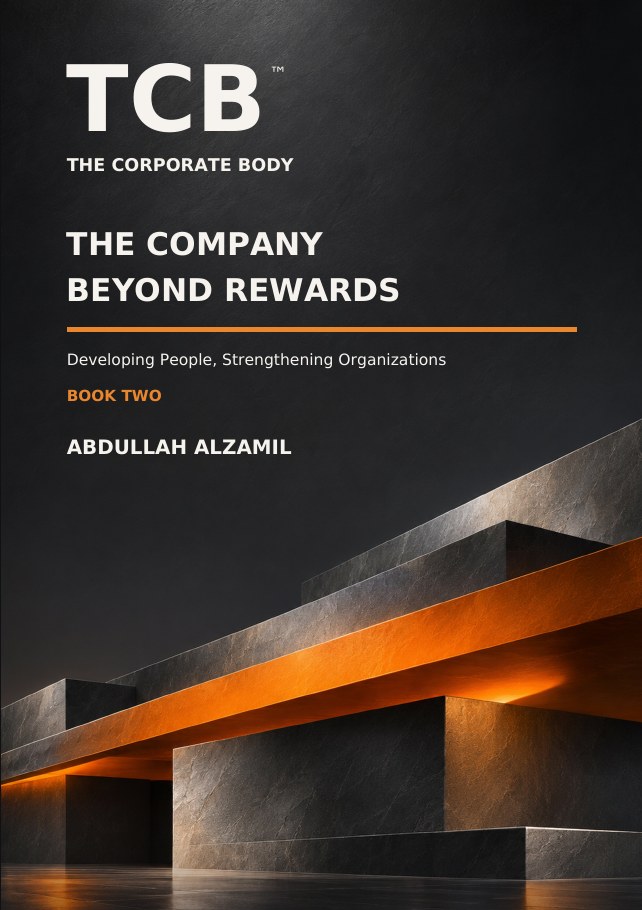
Cover of TCB: The Company Beyond Rewards
BOOK TWO

TCB: The Company Beyond Rewards

Developing people, strengthening organisations.
THE ESSENCE OF THE BOOK

Fair rewards are one part of a healthy company, not all of it. The second book adds three more parts: how goals and results connect across the company, how to measure the company's health the way a doctor measures a patient's, and what to do when the measurement shows a problem. It also shows how a company writes down its own DNA and notices when it drifts from it. Together the parts describe a company that stays healthy, not one that only pays fairly.

Who it is for: boards, executive teams and those who run strategy and performance.
20 chapters
206 pages
The health index
measured like a patient's
The company's DNA
written down and watched
Buy on Amazon Coming January 2027Read the executive summary
See the 20 chapters, and what each one covers
PART I · Foundation
  1. 1Return to the body
    Understand the analogy, the two well-beings, and the boundaries that keep the metaphor useful.
  2. 2What Book One established: TCB-CAM
    Identify exactly what CAM decides before using its outputs elsewhere.
  3. 3Why this sequel exists
    Connect fair rewards with the unanswered questions about people, continuity, and recovery.
  4. 4Learn from existing methods without becoming a patchwork
    Recognize what other methods contribute, where their scope ends, and what TCB integrates.
  5. 5One ecosystem, different decisions
    Follow the evidence and decisions between CAM, PN, CHI, and Corporate Healing.
PART II · Performance and people
  1. 6Performance Nexus: commitments that connect
    Connect strategy, employees, and cross-functional delivery without redefining KPIs or OKRs.
  2. 7One annual record, a two-way conversation
    Use one record to explain performance and open the next development cycle.
  3. 8Development as nourishment and exercise
    Choose development that addresses a real need and verify its application.
  4. 9Progression without forcing a vacancy
    Separate development progress, eligibility, opportunity, and appointment.
  5. 10Succession as a culture, not a secret list
    Assess readiness for actual responsibilities without quotas or secret career decisions.
  6. 11Leadership accountability without automatic blame
    Review information, authority, support, decisions, and response, not only the result.
  7. 12Sustainable incentives: pay for healthy contribution
    Keep separately paid incentives consistent with CAM’s reward-integrity principles.
PART III · Health and recovery
  1. 13Sustaining Employee and Organizational Well-Being
    Connect organizational viability, sustainable workload, development, and recovery to ordinary management commitments.
  2. 14TCB-CHI: a practical Corporate Health Index
    Use eight dimensions, explicit data requirements, and protected warning signals.
  3. 15Corporate Healing: restore function, protect the whole
    Connect diagnosis, executive choice, treatment, and verified recovery across all four pillars.
  4. 16Corporate DNA: what the body is measured against
    Define the company’s DNA, separate what is stable from what adapts, and treat drift as a question to answer, not a fault to punish.
PART IV · AI and implementation
  1. 17AI as an assistant, never the decision-maker
    Use AI to prepare evidence, reveal gaps and support better questions across all four pillars. Keep approval, judgment and responsibility with people.
  2. 18Implement without making people work for the model
    Use existing systems and a bounded pilot before increasing scope or consequences.
PART V · The complete case
  1. 19Namaa Horizon Bank: the complete five-year journey
    Follow the same people, sources, decisions, and numbers across five teaching years.
PART VI · Conclusion
  1. 20Beyond Rewards, Not Away from Performance
    Judge TCB by the decisions it clarifies and the outcomes it can demonstrate.
Plus appendices: the integrated employee record and question bank, the CHI input dictionary, and more working tools.
Interactive editions
Every chapter with its figures, a quiz per chapter and the working tools. For readers who bought the book.
Coming soon
From the books to a system
TCB Core puts the method in one place, so it runs without spreadsheets. It is being built now.
Abdullah Alzamil at a window with a stack of books
ABOUT THE AUTHOR

Abdullah Alzamil

Author and founder. More than two decades in Saudi financial institutions, including helping to build a digital bank. Certified Marshall Goldsmith executive coach.

"Perhaps the most important idea awakened by this book will not be mine."

Our story, mission, vision and values →